

- A joint VA loan allows non-military borrowers to share a VA loan with an eligible Veteran.
- A down payment may be required for non-military borrowers.
For many military members, the dream of homeownership often comes with personal relationships and financial strategies outside the military community. It's not uncommon for a service member to consider buying a home with a non-military individual, whether it’s a family member, friend or life partner.
A joint VA loan allows you to enjoy the benefits of a VA loan as long as one of the borrowers meets the eligibility requirements.
What is a Joint VA Loan?
A joint VA loan refers to a mortgage loan backed by the U.S. Department of Veterans Affairs (VA) where at least one of the borrowers is eligible for a VA loan. Two or more individuals may apply for a VA joint loan together, and all those on the loan will be held responsible for payments and share ownership of the home.
These loans don’t require any mortgage insurance or a down payment for the Veteran’s portion, which can be a huge advantage for borrowers. The VA guaranty covers a portion of the outstanding balance if the borrower defaults, which allows more favorable terms and competitive va loan interest rates.
Traditional VA Loan vs Joint VA Loan
The main difference between a traditional VA loan and a joint VA loan comes down to who's borrowing and how the VA guaranty applies.
With a traditional VA loan, the borrower is either a Veteran alone or with their spouse. The entire loan is covered by the Veteran's entitlement, so the VA guaranty applies to the full loan amount, which is why no down payment is required.
With a joint VA loan, the guaranty applies only to the Veteran's ownership share. If that guaranteed portion falls short of 25% of the total loan, borrowers may need to cover the gap with a down payment. That's why the Veteran's share of ownership and available entitlement matter so much in a joint loan scenario.
The other key distinction: a traditional VA loan with a co-borrower still requires that co-borrower to be VA-eligible. Joint VA loans open the door for non-military borrowers to be on the loan.
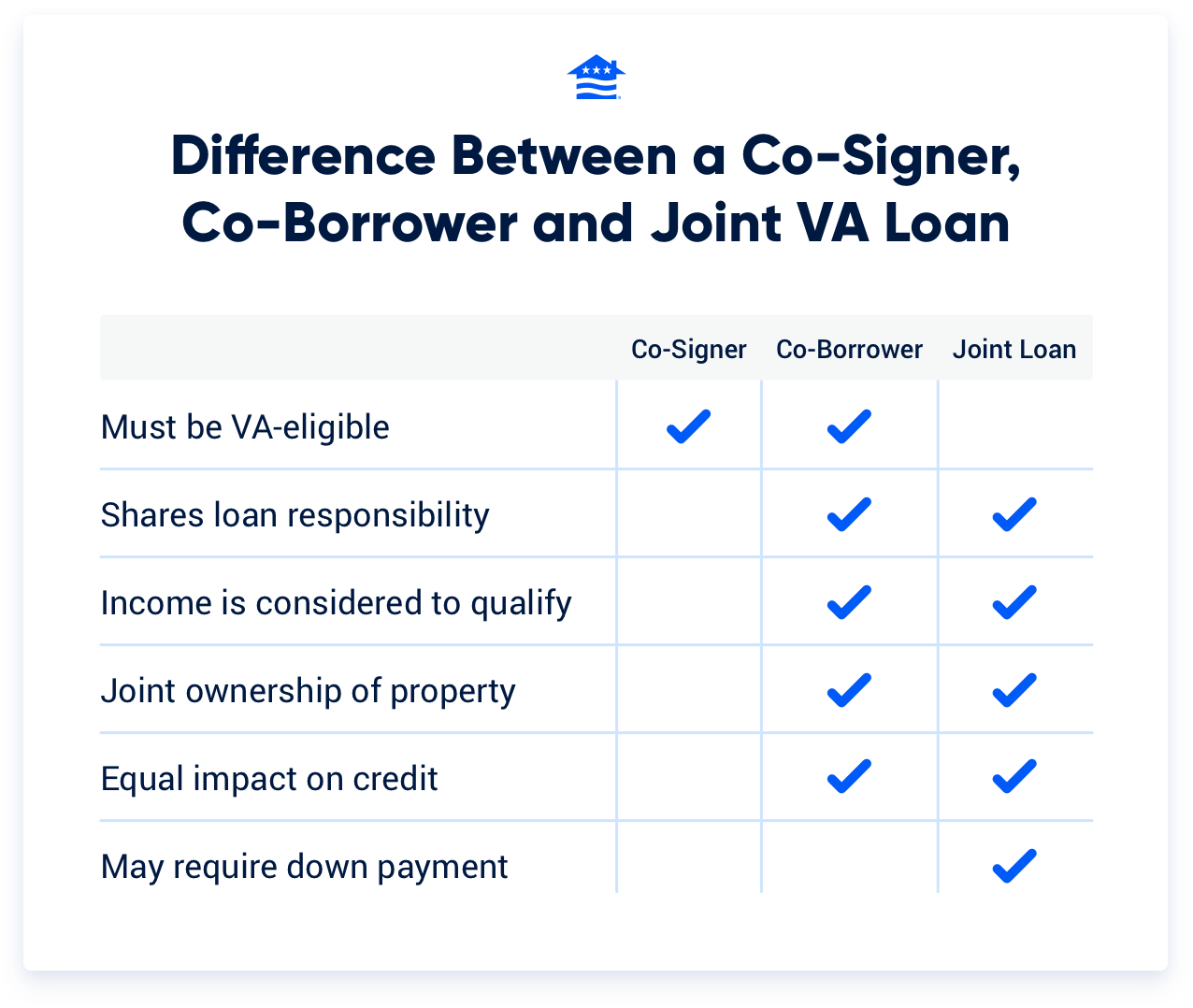
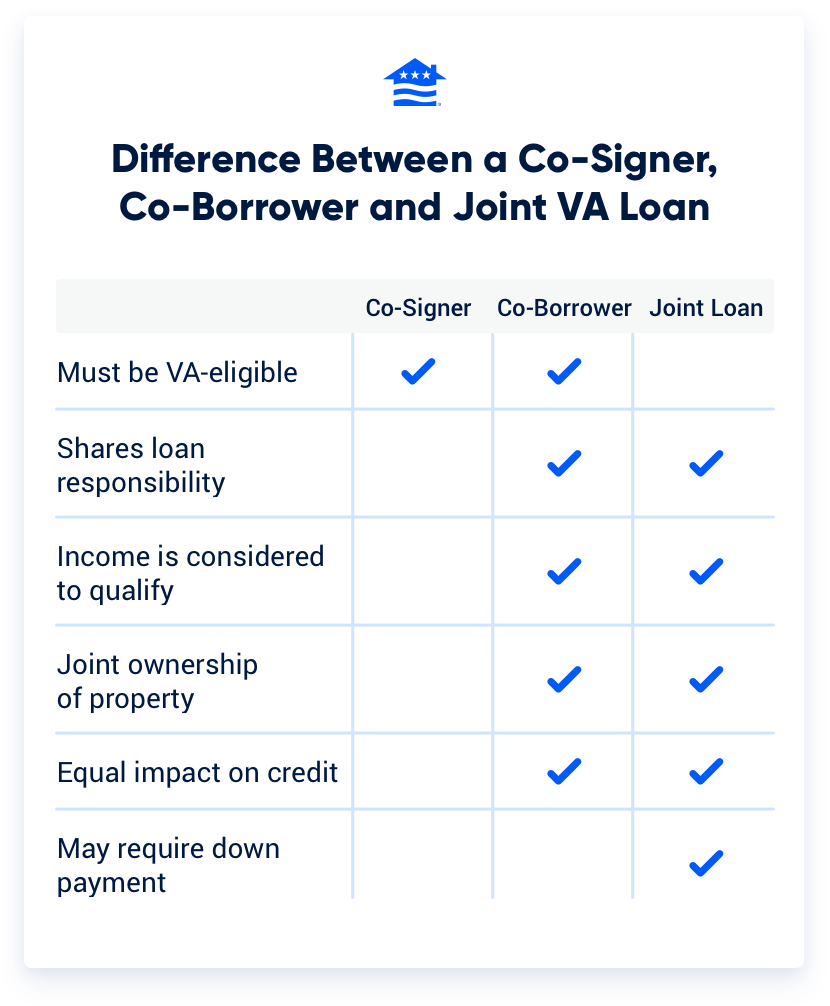
Who Can Get a Joint VA Loan?
The VA has certain restrictions on who can be on the loan for it to be considered a joint VA loan. It’s important to understand that VA loans function differently based on the marital status of the borrowers.
A VA loan involving a Veteran and a spouse is usually not treated as a joint loan if the spouse is not a Veteran or a Veteran not using entitlement on the loan. VA loans treat a Veteran and their spouse as a single entity, even if only one of them meets the service requirements. When a Veteran and a non-Veteran borrow together, it is considered a joint VA loan.
Use the table below to see how common joint VA loan borrower combinations are classified.
Joint VA Loan Borrower Scenarios
| Borrower Combination | Joint VA Loan? | Both Borrowers Must Be VA-Eligible? | Down Payment Needed? |
|---|---|---|---|
| Veteran + spouse (non-Veteran or Veteran not using entitlement) | No | No, just the Veteran using entitlement | Only if the loan amount exceeds the Veteran's remaining entitlement |
| Veteran + non-spouse, non-Veteran | Yes | Yes | Yes, the non-Veteran's portion of the loan isn't covered by VA entitlement |
| Veteran + Veteran(s) (not using entitlement and not a spouse) | Yes | No, just the Veteran using entitlement | Only if the loan amount exceeds the Veteran's remaining entitlement |
| Two unmarried Veterans (both using entitlement) | Yes | Yes | Only if the loan amount exceeds both Veterans' combined entitlement |
| Two married Veterans (both using entitlement) | Yes | Yes | Only if the loan amount exceeds both Veterans' combined entitlement |
Let’s walk through a few common joint VA loan scenarios.
Scenario 1: Veteran + Non-Veteran
A Veteran and a civilian friend buy a $400,000 home together with 50/50 ownership. The VA guarantees 25% of the Veteran's $200,000 share, covering $50,000 of the total. But lenders typically require a 25% guaranty on the full loan amount, or $100,000 total.
That $50,000 gap would likely need to be covered with a down payment.
Scenario 2: Two Veterans Using Unequal Entitlement
Two unmarried Veterans, Doug and Lisa, buy a $300,000 home together, splitting the loan 50/50. Doug has full entitlement and Lisa has $50,000 of remaining entitlement. Together, their combined guaranty clears the lender's $75,000 requirement (25% of $300,000), so no down payment is needed.
Scenario 3: Veteran With Limited Entitlement + Non-Veteran
A Veteran with only $80,000 of remaining entitlement wants to buy a $500,000 home with a non-Veteran co-borrower. The lender requires $125,000 in guaranty coverage (25% of $500,000), but the VA can only back $80,000.
To close that $45,000 gap, the borrowers would need to put down at least $45,000, roughly 9% of the purchase price. At that point, a VA loan may not be the best fit. You should talk with your loan officer about other financing options.
Joint VA Loan Requirements
In addition to traditional VA loan requirements, there are joint VA loan guidelines to be aware of:
- Any loan involving a non-spouse borrower requires VA prior approval before closing. This review doesn't happen until the lender has completed full underwriting, typically near the end of the buying process.
- The Veteran using entitlement must intend to occupy the property as their primary residence.
- The creditworthiness and income of all borrowers are considered during underwriting.
- A down payment may be required if the Veteran's guaranteed share doesn't cover 25% of the full loan amount.
- Only the Veteran using entitlement is responsible for the VA Funding Fee, calculated on their share of the loan (unless they qualify for an exemption).
Answer a few questions below to speak with a specialist about what your military service has earned you.
Pros and Cons of Joint VA Loans
| Pros | Cons |
|---|---|
| May qualify easier with multiple | Must pay VA Funding Fee |
| Only one borrower must be VA-eligible | May require down payment for non-military borrowers |
| Multiple incomes can increase buying power and home budget | May tie up entitlement, making it harder to reuse VA benefits |
VA Entitlement and Joint Loans
VA loan entitlement is the amount the VA guarantees on a home loan. The VA will only guarantee the Veteran's portion of the loan, so a down payment might be necessary if there's a non-military borrower on the loan who isn't your spouse.
When two or more VA-eligible borrowers apply together, not every borrower is required to use their entitlement. If only one borrower uses their entitlement, the VA will guarantee only 25% of the loan amount covered by the Veteran using entitlement.
If both VA-eligible borrowers want to use their entitlement, that is completely acceptable and referred to as dual entitlement for a VA loan. However, a written agreement is required if there is unequal entitlement usage between Veterans.
-
“A down payment is typically required for a joint VA loan and often around 12.5% of the purchase price, though it can vary based on the Veteran’s entitlement and loan details. Even with this requirement, VA loans can still be advantageous since borrowers may put less than 20% down and avoid monthly mortgage insurance.”
 Will LewisAssociate Director of Production - NMLS #187652
Will is an Associate Director of Production at Veterans United, bringing 16 years of mortgage lending experience and a deep passion for helping those who serve.
When to Use a Joint VA Loan
There are certain instances when a joint VA loan may be your best choice. Let’s take a look at some common scenarios:
- Purchasing with a non-Veteran friend or family member: A Veteran looking to purchase a home with a friend who isn’t a spouse or family member might opt for a joint loan.
- Unmarried couples: A joint VA loan can offer the perfect solution for a Veteran and their unmarried partner to co-purchase a home while leveraging the Veteran's benefits. If a Veteran plans to buy a home with a fiancé who is a non-Veteran and they want to close the loan before getting married, a joint loan would be necessary.
- Combined resources: A Veteran might want to pool resources with a non-Veteran to afford a more expensive property that would be beyond their individual financial reach.
- Purchasing a multifamily home with more than four units: A Veteran co-owning a property with other eligible Veterans can have four residential units, one business unit and an additional unit for each participating Veteran.
- Second VA loan: If a Veteran has already used their entitlement on a home but has some remaining, they might use a joint loan with another Veteran who has full entitlement on a second home.
In each of these cases, it's crucial to understand that the VA will only guarantee the portion of the loan corresponding to the eligible Veteran's entitlement, and non-Veterans on the loan will typically need to make a down payment on their share of the purchase.
Connect with a Veterans United VA loan expert at 855-870-8845 or get started online to see if you qualify for a joint VA loan and discuss your options.
How We Maintain Content Accuracy
Our mortgage experts continuously track industry trends, regulatory changes, and market conditions to keep our information accurate and relevant. We update our articles whenever new insights or updates become available to help you make informed homebuying and selling decisions.
Current Version
Aug 14, 2026
Written ByChris Birk
Reviewed ByDon Wilson
Added joint VA loan borrower scenarios table and quotes from Veterans United VA loan experts.
Feb 19, 2025
Written ByChris Birk
Reviewed ByDon Wilson
Minor content updates and fact checked by underwriter Don Wilson.

Related Posts
-
 How to Make an Offer on a HouseOnce you’ve found the right home, you need to know how to put together a purchase offer. Learn tips for putting an offer on a house with a VA loan.
 -
 4 Tax Breaks for Homeowners in 2026Owning a home not only offers a sense of security but can also lead to significant tax savings. Discover the top tax deductions and credits available to homeowners so you can enjoy the perks of homeownership – even at tax time.


